01
Overview
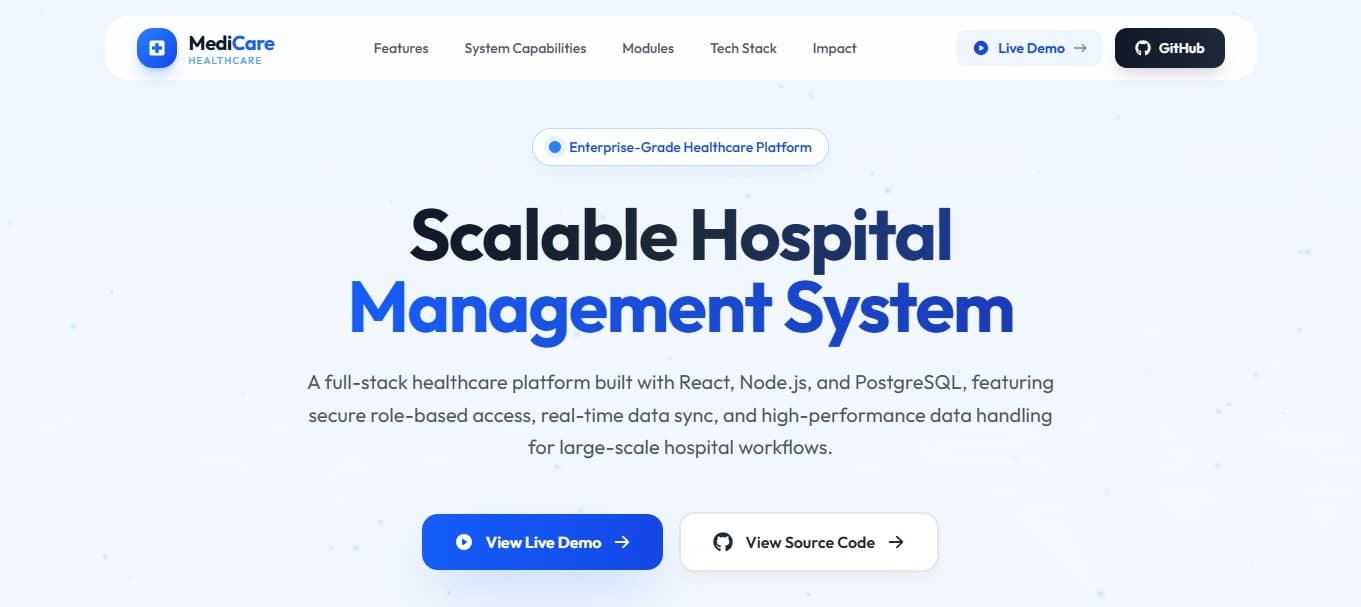
A scalable hospital management web application built using a modern full-stack architecture with TypeScript, Express.js, Prisma ORM, and PostgreSQL, designed to handle secure healthcare workflows and large-scale data operations efficiently.
Implements secure RBAC-based authentication with JWT access/refresh tokens, enabling administrators to control user provisioning and permissions across roles such as doctors, nurses, and staff within the healthcare system.
Features a high-performance data layer with multi-layer caching, cursor-based pagination, and optimized database queries, while the React + React Query frontend provides real-time data synchronization, responsive UI, and centralized API error handling.
02
Key Features
- ▹Full-stack hospital management platform built with React, TypeScript, Express.js, Prisma ORM, and PostgreSQL, designed to manage patients, admissions, doctors, billing, and hospital operations securely and efficiently.
- ▹Monorepo architecture with shared Zod validation schemas, enabling cross-layer type safety between frontend forms and backend APIs while eliminating duplicated validation logic.
- ▹Secure authentication and RBAC system using JWT access/refresh tokens, allowing administrators to provision staff accounts, control permissions, and revoke access dynamically.
- ▹High-performance backend data layer with multi-layer caching (memory + Redis), cursor-based pagination, and optimized database queries to support large hospital datasets.
- ▹Advanced search and filtering system powered by PostgreSQL indexing and query optimization, enabling fast lookup across patients, admissions, and healthcare records.
- ▹React Query data architecture for automatic caching, background refetching, and mutation handling, ensuring consistent real-time UI updates without manual refresh.
- ▹Centralized API communication layer using Axios interceptors for consistent error normalization, authentication handling, and reliable API requests.
- ▹Dynamic hospital data tables built with TanStack Table, supporting sorting, filtering, and efficient pagination for managing large datasets.
- ▹Form handling and validation system using React Hook Form + Zod, providing strong client-side validation and improved user input reliability.
- ▹Modular frontend architecture with reusable hooks, API layers, and feature-based structure to maintain scalability and clean code organization.
- ▹Production deployment setup using Vercel (frontend) and Render (backend) with environment configuration and secure API communication.
03
Impact
- ▹Improved operational efficiency in clinical workflows through a centralized dashboard where staff can seamlessly manage patients, appointments, departments, and medical records.
- ▹Enhanced data accuracy and integrity using Zod-based validation across all forms, ensuring clean, validated data at both frontend and backend layers.
- ▹Faster decision-making supported by interactive data visualizations (via ApexCharts), enabling hospitals to analyze patient trends, appointment volume, and department performance in real-time.
- ▹Real-time updates and auto-syncing with React Query eliminate manual refreshes and keep patient data and appointment statuses always up-to-date, improving user satisfaction and response time.
- ▹Role-based security using JWT authentication and RBAC provides safe access levels for admins, doctors, and staff — protecting sensitive medical data from unauthorized use.
- ▹Cross-platform deployment pipeline using Vercel and Render with CI/CD ensures a production-ready and maintainable environment, minimizing downtime and deployment friction.
- ▹Increased developer productivity via a monorepo setup with shared type-safe schemas, reducing bugs and duplication in API validation and improving code maintainability.
- ▹Optimized performance on low-end systems through lazy loading, code-splitting, and compressed assets, ensuring smooth usage even with large hospital datasets.
- ▹Highly scalable system architecture with Prisma + PostgreSQL backend and modular Redux state management, ready to support multi-department clinics and growing hospital networks.
- ▹User-friendly experience through a minimal yet responsive UI, helping staff navigate quickly and perform tasks efficiently across both desktop and mobile devices.
04
Challenges Overcome
- ▹Designing a monorepo architecture with shared Zod schemas across frontend and backend, ensuring cross-layer type safety while avoiding duplicated validation logic and maintaining consistent API contracts.
- ▹Implementing a secure RBAC authentication system with JWT access/refresh tokens, handling admin-driven user provisioning, permission enforcement, and runtime access revocation across multiple staff roles.
- ▹Building a high-performance data retrieval layer with multi-layer caching and cursor-based pagination, optimizing queries and reducing database load while maintaining data consistency across large hospital datasets.
- ▹Managing complex frontend server-state synchronization using React Query, including cache invalidation, mutation handling, and consistent UI updates across multiple interconnected modules.
- ▹Handling deployment and environment configuration for a full-stack monorepo application across Vercel and Render, ensuring reliable builds, environment isolation, and secure API communication.
05
Tech Stack